
THANK YOU FOR SUBSCRIBING
× 
Enterprise Security Mag Weekly Brief
Be first to read the latest tech news, Industry Leader's Insights, and CIO interviews of medium and large enterprises exclusively from Enterprise Security Mag
Enterprise Security Magazine

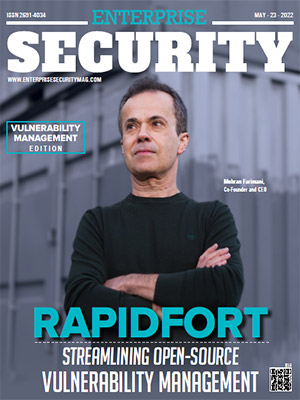
RapidFort
Streamlining Open-Source Vulnerability Management

Just before the deployment of the product, the Infosec team scanned the system and reported 4500 OSS vulnerabilities in the set of 12 containers, with more than 1000 high and critical severity issues. The release was put on hold until the vulnerabilities were remediated or justified as inapplicable.
Needless to say, the incident delayed the software release for another six months. During this time, new vulnerabilities were reported against the OSS components, and a small handful was addressed by newer versions of the OSS packages. Though the software was later deployed successfully, this incident unfolded a new requirement in the software development space—providing developers with greater visibility into the vulnerabilities that pop up during software development.
As seasoned software engineers, Mehran Farimani and his cofounder, Rajeev Thakur, were quick to identify this critical need. “Deploying code into production presents inherent risks as the majority of software is built using trusted open-source components,” says Farimani. Unfortunately, this is not just the case with one developer but an issue that plagues the entire software development industry.
Solving a Long-Standing Problem
A software application typically utilizes a fraction of the functionalities provided by open-source packages and about 50-90 percent of the software components in the production workloads are left unused. They can readily be exploited even in high security environments with golden base images and advanced policy enforcement tooling. An intruder who has access to an organization’s infrastructure can use these unused software components to facilitate their lateral movement and gain deeper access to critical data. This poses a significant threat to enterprises’ security framework and weighs down their critical operations. The proliferation of microservice-based, containerized architecture has also escalated the software supply chain risk.

To alleviate these challenges, Farimani and Thakur started pondering over ways to help developers gain meaningful insights on what their workload does and how to mitigate associated vulnerabilities. This is the very idea behind the inception of RapidFort, a California-based software attack surface optimization platform provider.
Founded in 2020, RapidFort adopts a comprehensive “shift left” approach to design and develop an intuitive platform that continuously monitors and minimizes clients’ software attack surfaces. The solution profiles clients’ containers without disrupting the software production workload, automatically removes vulnerabilities that are not in the execution path of the workload, and identifies packages that they need to maintain. It creates optimized workloads by removing 50-90 percent of unused components.
“The elimination of vulnerable elements from clients’ workload helps improve their security posture, optimize infrastructure, and enhance organizational nimbleness,” says Farimani, who is currently donning the role of the CEO at RapidFort.
The Right Way to Reduce Vulnerabilities
The traditional way of securing network perimeters to protect organizational infrastructure is not enough as the software itself presents a huge attack surface. “Today, when you talk about attack surface management in the industry, you’re always referring to the network attack surface, and there are many great solutions available in the market to manage your network attack surface. But the software itself presents a large attack surface that an organization needs to manage, and there are no tools available to understand and manage that, until now,” says Farimani. The RapidFort Platform, to this end, has been designed to empower developers, infrastructure, and security teams to quickly build, test, and deliver optimized workloads while staying secure a new category that Farimani calls a “Software Attack Surface Management” platform (SASM).
“We’re creating a paradigm shift in the vulnerability management space with our robust platform”
The solution provides teams with a holistic view of all the open-source packages in use and associated vulnerabilities even before they go to production by leveraging its scanning component. It performs a static scan every time a workload is introduced to the system. The process enables the platform to understand the Software Bill of Materials (SBOM), components installed, vulnerability associated with the components and file structure. It then goes further to create a Real Bill of Materials (RBOM) that includes only the components that are used. “Optimizing the BOM is an essential practice in manufacturing. Yet when it comes to software, we put no emphasis on this practice. The RBOM achieves this, and RapidFort generates it automatically,” says Farimani.

The RapidFort Platform has a statistical model incorporated within to evaluate the workload and provide an estimate on possible software bloat, optimization, and reduction in vulnerabilities, packages, and attack surface. The solution’s profiling component encompasses a complete suite of effective and efficient techniques that help instrument clients’ workloads. By gathering behavioral information about the workloads as they run in their natural runtime environment, the solution delivers deep insights into the components used in the operation.
The optimization module, on the other hand, includes a set of powerful tools that clients can leverage to repackage their workload based on this critical information in a way that best suits their operations. As a result, they can reduce the size of their workload and package the necessary components to achieve their goals. All these ultimately get integrated into automatic build and release cycles, where each workload gets optimized before it goes into the production systems. An optimized workload means fewer vulnerabilities and less zero-day attack exposure. Smaller workloads also boot significantly faster and move along the different parts of the pipeline efficiently.
Outperforming the Competition
“We’re creating a paradigm shift in the vulnerability management space with our platform,” adds Farimani. Primarily, from a vulnerability and patch management perspective, clients can decrease the number of packages used by 60-90 percent, while narrowing down known vulnerabilities and subsequently, software attack surface by 80 percent, depending on the languages and frameworks used to build the workload.
This plays a vital role in eliminating software supply chain risks, decreasing zero day exploit risk, and reducing patch management backlog. Needless to say, security teams can now focus on eliminating threats, achieving required certification, satisfying compliance requirements, and accelerating their container load times.
With undivided attention to individual customer problems and a proven platform, RapidFort has gleaned a broad customer base since its beginning. The company recently collaborated with one of its mid-range clients that operated about 50 containers across a few applications. The client had recently leveraged the RapidFort platform to optimize their workloads for a new deployment model. As a result, they were able to reduce 38,000 vulnerabilities to a mere 4,000, a 90% improvement.
RapidFort’s new deployment model enables clients to spend their time improving test cycles rather than just chasing down vulnerabilities. As such, they can stay competitive in terms of business operations. In other words, the company's offerings allow developers to redirect their focus on designing and building new software, adding features to existing ones, and addressing customer needs. Being able to reduce the number of packages, vulnerabilities, and unused components in the production workload, the RapidFort Platform allows clients to be more nimble.

RapidFort is also sought after for its ability to offer the workload in a secure way so that clients can easily and safely load their investigation debugging tools into production workloads. To leave these tools in the production workloads presents a significant threat for organizations as they can facilitate cyber criminals’ lateral movement within clients’ infrastructure. The company goes the extra mile to make sure these debugging tools are no longer available for use once the investigation process has been completed by authorized people.

The elimination of vulnerable elements from clients’ workload helps improve their security posture, optimize infrastructure, and enhance organizational nimbleness

With undivided attention to individual customer problems and a proven platform, RapidFort has gleaned a broad customer base since its beginning. The company recently collaborated with one of its mid-range clients that operated about 50 containers across a few applications. The client had recently leveraged the RapidFort platform to optimize their workloads for a new deployment model. As a result, they were able to reduce 38,000 vulnerabilities to a mere 4,000, a 90% improvement.
These instances of client success always drive RapidFort to explore new avenues of innovation and growth. The company continues to up its ante in the market by accumulating feedback from its customers and utilizing these valuable insights in its product development endeavors to provide better operational efficiency and excellence. It also works in liaison with several industry experts, advisors, and partners to identify the latest trends and challenges in the vulnerability management space. This helps in building more practical solutions and adding new features and functionalities to its platform to rapidly align with the ever evolving market dynamics.
The coming year will witness RapidFort adding new service to its portfolio supporting the optimization of VM workloads. It’s also putting the best foot forward to understand and solve zero-trust problems in containerized environments, intending to position itself as a one-stop vulnerability management and workload optimization expert. Intending to pioneer in the “Software Attack Surface Management” space, team RapidFort is on a tireless effort to bring it to the mainstream as quickly as possible.
Insights from OSS Summit 2022: SBOMs, Critical Infrastructure
Russ Andersson: COO & CRO, RapidFort Inc.


Company
RapidFort
Management
Mehran Farimani, Co-Founder and CEO and Rajeev Thakur, Co-Founder and CTO & Russ Anderssen, CCO
Description
Founded in 2020, RapidFort adopts a comprehensive “shift left” approach to design and develop an intuitive platform that continuously monitors and minimizes clients’ software attack surfaces. The solution profiles clients’ containers without disrupting the software production workload, automatically removes vulnerabilities that are not in the execution path of the workload, and identifies packages that they need to maintain. It creates optimized workloads by removing 50-90 percent of unused components. The RapidFort Platform has been designed to empower developers, infrastructure, and security teams to quickly build, test, and deliver optimized workloads while staying secure—a new category that Farimani calls a “Software Attack Surface Management” platform (SASM).
RapidFort News
RapidFort surpasses one million downloads of its hardened public container images
RapidFort’s Platform Now Available in Microsoft Azure Marketplace
SAN FRANCISCO--RapidFort, the San Francisco-based cybersecurity startup pioneering Software Attack Surface Management (SASM), is now available in the Microsoft Azure Marketplace, an online repository containing IT software applications and services built by industry-leading technology companies. Customers now have access to the powerful -- Azure optimized -- features of the RapidFort platform to scan, monitor and harden workloads running in Microsoft Azure Kubernetes Services.
RapidFort’s technology will be the first of its kind available on the Azure marketplace and can be fully deployed on the Azure stack within a customer account. With no data leaving the customer account, customers remain secure and can enforce organizational security policies while leveraging the benefits of the RapidFort platform. The locality of the platform and RapidFort Runtime Protection features also allow for accelerated scanning of Common Vulnerabilities and Exposures (CVEs) as all data is local to customer workloads.
“Our inclusion in the Microsoft Azure Marketplace is another crucial step forward in our go-to-market strategy as we expand access to our powerful solution, and tackle the growing challenge of software security,” said Mehran Farimani, CEO at RapidFort. “This affirms our innovative approach to software attack surface management. As we expand access to our platform, we're expediting our mission, empowering customers to effortlessly secure and optimize their software with the operational efficiency and security benefits of RapidFort."
RapidFort’s inclusion in the marketplace serves as further testament to their mission of creating a seamless approach for customers to access its technology. The complete integration of the platform into the Azure Marketplace greatly benefits regulated industries such as financial services and healthcare, as it will allow customers to leverage their existing certifications alongside the benefits of the RapidFort platform.
RapidFort was also recently selected to be in the prestigious Microsoft For Startups Pegasus Program. This in addition to the listing demonstrates the company’s continued dedication to better serve its current and prospective customers by increasing access to its market-leading platform and making it easier than ever to remediate software vulnerabilities.
RapidFort’s technology will be the first of its kind available on the Azure marketplace and can be fully deployed on the Azure stack within a customer account. With no data leaving the customer account, customers remain secure and can enforce organizational security policies while leveraging the benefits of the RapidFort platform. The locality of the platform and RapidFort Runtime Protection features also allow for accelerated scanning of Common Vulnerabilities and Exposures (CVEs) as all data is local to customer workloads.
“Our inclusion in the Microsoft Azure Marketplace is another crucial step forward in our go-to-market strategy as we expand access to our powerful solution, and tackle the growing challenge of software security,” said Mehran Farimani, CEO at RapidFort. “This affirms our innovative approach to software attack surface management. As we expand access to our platform, we're expediting our mission, empowering customers to effortlessly secure and optimize their software with the operational efficiency and security benefits of RapidFort."
RapidFort’s inclusion in the marketplace serves as further testament to their mission of creating a seamless approach for customers to access its technology. The complete integration of the platform into the Azure Marketplace greatly benefits regulated industries such as financial services and healthcare, as it will allow customers to leverage their existing certifications alongside the benefits of the RapidFort platform.
RapidFort was also recently selected to be in the prestigious Microsoft For Startups Pegasus Program. This in addition to the listing demonstrates the company’s continued dedication to better serve its current and prospective customers by increasing access to its market-leading platform and making it easier than ever to remediate software vulnerabilities.

SAN FRANCISCO, CALIFORNIA - RapidFort, a San Francisco-based container security company, surpassed one million downloads of its free, hardened container images. With this milestone, RapidFort continues its mission to deliver powerful, effective, and simple solutions to security and development teams.
RapidFort's Community Images project (www.rapidfort.com/community) is a growing bank of popular container images, optimized and hardened using RapidFort's platform. The hardened images are functionally identical to their original versions, with far fewer vulnerabilities and a significantly smaller software attack surface.
As the industry shifts to cloud-native applications with rapid release cycles, security teams are inundated with critical and high-severity vulnerability alerts in their containerized environments. It is often difficult and time-consuming to determine which vulnerabilities are exploitable and must be prioritized. RapidFort's Community Images have become popular within the DevSecOps community because they remove unused packages and their associated vulnerabilities.
Across the 60+ images currently in RapidFort's Community Images project, hardened images are, on average, 64% smaller and contain 71% fewer vulnerabilities. The smaller optimized images load much faster, produce far fewer vulnerability alerts, and significantly reduce the patch management burden without new tooling or workflow changes. Infrastructure teams gain cost and security benefits from these smaller container images with minimal attack surface.
"Cybersecurity is challenging, and security teams have a tough job. Our mission is to build products that help reduce the burden on security and development teams with practical solutions. Our Community Images project is a good example. We provide it as a free service to the community and will continue to invest in growing its scope and reach. It's exciting to see that people are finding it useful. One million unique downloads is a large number, and it's all organic adoption," said Mehran Farimani, CEO of RapidFort.
The RapidFort team has open-sourced the hardening scripts via their GitHub repository. The team will continue adding new images for free and takes requests for new images via its GitHub page.
Founded in 2020, RapidFort has been helping security and engineering teams understand and secure their software infrastructure with innovative solutions.