
THANK YOU FOR SUBSCRIBING
× 
Enterprise Security Mag Weekly Brief
Be first to read the latest tech news, Industry Leader's Insights, and CIO interviews of medium and large enterprises exclusively from Enterprise Security Mag
Enterprise Security Magazine: Specials Magazine
Kim Larsen is the Group Chief Information Security Officer (CISO) at Keepit, with more than 20 years of leadership experience in IT and cybersecurity across government and the private sector. He specializes in business-driven security, aligning corporate, digital, and security strategies with risk management and threat mitigation appropriate for managing risk in line with real business priorities. As a seasoned keynote speaker, negotiator, and board advisor, Kim has worked with organizations including NATO, EU institutions, Verizon, Systematic, and multiple industry security boards, operating at the intersection of geopolitics, technology, and executive decision-making. Could You Talk About Your Professional Journey And Current Responsibilities As The Ciso At Keepit? I have built my career in environments where trust, resilience, and operational discipline are not optional. That includes time in the police and military, as well as international institutions and global technology companies. Those environments teach you very quickly how to separate signal from noise, how to prioritize under pressure, and how to reduce risk in ways that hold up in the real world, not just in policy documents. Working across international contexts also teaches you that security has to function across cultures, regulatory systems, and complex supply chains. If it cannot operate consistently across those realities, it does not scale. For me, that means building frameworks that are clear, measurable, and practical so teams can apply them consistently rather than simply understand them in theory. During my time supporting large global networks, including at Verizon, I learned a lesson that still guides me. Security cannot be added at the end. It has to be engineered into systems, processes, and decisions from the beginning. “Alignment happens when leadership can clearly see the trade-offs. They need to understand what we are protecting, why it matters, and what good actually looks like.” At Keepit, my responsibility is to protect customer data and strengthen our cyber resilience as we grow internationally. I see security as a business capability. My role is to ensure we have the right controls, genuine visibility into risk, and a culture where security supports our mission to deliver trusted, future proof SaaS data protection. As Cyber Threats Become Increasingly Dynamic And Unpredictable, How Do You Envision The Ciso Role Evolving, Especially Within Cloud-Based Backup And Recovery Environments? The threat landscape has shifted. We are no longer dealing primarily with isolated incidents. We are dealing with persistent pressure, disruption, and targeted interference with infrastructure and data. That is becoming the baseline. I think the role of the CISO is moving away from the illusion of control and toward something more honest and durable. The first step is acknowledging what we do not control. From there, the real work begins, which is building visibility and resilience where it actually matters. In cloud based backup and recovery environments, the attack surface is broader than many people assume. It includes identities, integrations, administrators, APIs, and third parties. Risk accumulates in those dependencies. Managing that risk requires transparency with partners and vendors. It requires measurable and centrally governed security. Without that discipline, shadow IT expands quietly and accountability becomes fragmented. Frameworks such as NIS2 can be constructive because they introduce discipline at a time when risk evolves faster than traditional control models. But compliance is not the end goal. What matters is clarity. I need the board to understand our threat picture and trust the foundation behind it. That means translating complex signals into decisions leadership can act on. My responsibility is to reduce noise and elevate judgment.
Digital Magazine
Top Cyber Security Solutions In Europe 2026
Modern enterprises no longer operate as traditional IT environments. Instead, they span interconnected ecosystems of IT systems, operational technology (OT), IoT devices, OEM, industrial equipment, legacy infrastructure, and medical devices, many of which cannot support conventional security software or be taken offline without disrupting critical operations. While this convergence enables greater efficiency and connectivity, it also reduces visibility into network activity, overwhelms security teams with alerts, and makes it increasingly difficult to detect threats before they move across the environment. Cyber Evolution addresses this challenge through LECS, its patented Network Detection and Response (NDR) technology. Designed as a plug & play, agentless platform, LECS delivers unified visibility, Deep Traffic Intelligence, behavioral analysis, and autonomous response across IT, OT, and IoT environments. It continuously evaluates communication patterns across connected assets to identify anomalies, suspicious internal traffic, and lateral movement, then applies progressive countermeasures and provides contextual insights that security teams can quickly interpret and act on. “With LECS, our objective is to reduce noise rather than create more alerts. It gives organizations a practical way to understand increasingly complex network environments and respond with confidence, without adding unnecessary operational burden,” says Mr. Roberto Camerinesi - Cybersecurity Researcher - Inventor of the LECS Cybersecurity Patent - Co-Founder and CTO at Cyber Evolution | LECS. A Network-First Approach To Cyber Defense Cyber Evolution designed LECS to complement existing cybersecurity investments rather than replace them. Firewalls, antivirus platforms, EDR, SOC, and SIEM solutions continue to perform their roles, while LECS adds a network intelligence layer that analyzes communications between connected assets through Deep Packet Inspection (DPI) and behavioral analysis. This helps security teams uncover suspicious internal traffic, detect lateral movement, and identify threats across legacy equipment, industrial systems, IoT devices, and other assets where software installation may be impossible or undesirable.

Top Remote Access Software Suite in Europe 2026

Every time a business-critical application is deployed at another office, branch, or customer site, the organisation inherits yet another environment that must be kept updated, secure, and operational. At a small scale, this burden may be manageable. But across hundreds or thousands of users, it can quickly become a constraint on growth. Software versions start to diverge, updates must be rolled out repeatedly, and support teams are left troubleshooting applications across devices and locations they do not directly control. TSplus prevents that complexity from multiplying. Its Remote Access software enables Windows applications to run from a central server or cloud environment while authorised users access them remotely. Rather than maintaining separate installations for each user, an organisation can manage the application from a single point and extend access wherever needed. SpaSalon.com, a U.S. software provider serving approximately 50,000 beauty salons, illustrates the difference. Its application manages appointments, accounting, and other daily operations. Installing it at every location would have required thousands of separate deployments and repeated updates across its customer base. With TSplus Remote Access, SpaSalon.com hosted the application centrally and made it available to salons remotely. Updates could be applied once within the hosted environment, allowing the company to expand access without a corresponding increase in installation and maintenance work. Seven years later, SpaSalon.com continues to rely on TSplus. Whether it is a hotel managing reservations, a transportation company coordinating deliveries, or a manufacturer running plant operations, TSplus keeps the applications behind these critical functions accessible to authorised users, while maintaining the control and consistency that businesses depend on.
CXO INSIGHTS
The Big Hunt
Nicola Sotira, Head of CERT

Combating Cloud-Based Cyber Attacks
Alberto Rey García, CISO - Global Infrastructure & IT Operations

AI and Cybersecurity A Practitioner's Perspective
Felix Kyei Asare, Director of Cyber Security Operations

Redefining Retail Banking in a Changing Financial Landscape
Ioannis Roussos, Head of Deposits & Investment Sector

Remote Access, Electronic Identification and Complete Process Automation Transforming Banks
Krasimir Vitanov, Head of Enterprise Cloud and Integration Solutions


IN FOCUS
Remote Access Software: A Catalyst for Change in the European Work Environment
Growing reliance on distributed work environments is increasing demand for remote access software suite solutions across Europe as organisations seek more seamless connectivity between employees, systems, and business applications. These platforms are enabling faster access to critical resources regardless of location, helping teams maintain operational continuity and improve collaboration across geographically dispersed workplaces.Enhanced management capabilities are also supporting more efficient oversight of digital assets, allowing organisations to streamline workflows and strengthen productivity. As enterprises continue to modernise workplace operations, remote access software suite deployments are playing an increasingly important role in supporting flexible and connected business environments.
Enhancing Cybersecurity Resilience in Europe: Solutions for a Safer Digital Future
Organisations are adopting more digital tools to work smarter, serve customers more effectively and support long-term growth. As businesses become increasingly connected, cyber threats are also evolving and becoming harder to spot.Companies now handle sensitive information through cloud services, remote work systems and a wide range of connected technologies. While these innovations create new opportunities, they also present security challenges. Organisations must adopt a proactive approach to safeguard their systems and data against cybercriminals who continually seek to exploit weaknesses.
EDITORIAL
Building Resilience into Cybersecurity
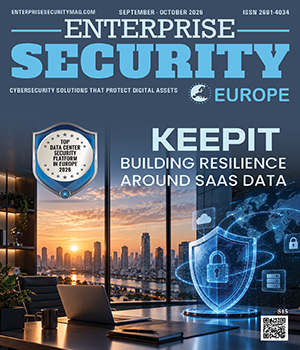
Cybersecurity today extends far beyond protecting a defined IT perimeter. As organisations connect more applications, data, devices and critical operations across increasingly complex environments, the ability to withstand disruption and recover with confidence has become just as important as prevention. This edition of Enterprise Security Magazine Europe explores how security leaders and technology providers are strengthening resilience through greater visibility, practical controls and organisational readiness.
Our cover story features Keepit, recognised as the Top Data Center Security Platform in Europe 2026. The company approaches SaaS data protection through independence, operating its own cloud infrastructure to keep backup data separate from production environments. Automated backups, granular recovery, immutable storage and regional data residency give organisations greater control over how critical information is protected and restored.
Also recognised is TSplus, the Top Remote Access Software Suite in Europe 2026, which combines centralised application access with layered protection for the infrastructure supporting it. Cyber Evolution | LECS, recognised as the Top Cyber Security Solutions in Europe 2026, brings agentless network visibility across IT, OT and IoT environments to help security teams identify meaningful threats without adding unnecessary operational burden.
Victor Pettersson, CISO at Sokigo, is also recognised among the Top 10 CISOs in Europe 2026 for his work in strengthening security as a shared organisational responsibility through education, engagement and continuous improvement.
The issue also features perspectives on resilience beyond technology alone. Peter Coughlan, Associate Director for Supply Chain Risk Management at Alkermes, discusses that genuine readiness comes from understanding operational dependencies, testing realistic disruption scenarios and placing ownership close to where decisions are made. Bernard Gavgani, Senior Advisor to the Group's General Management at BNP Paribas, examines the growing importance of collective cybersecurity capacity, stronger governance and international cooperation as digital threats become increasingly borderless.
Taken together, these stories show that effective security is built through preparation as much as protection. We invite our readers to explore these perspectives and discover how European organisations are building security practices designed to hold when they matter most.
